Featured

Feminism. A Random Male Perspective.

Why I am writing this?

Short answer?

This is for a women studies project.

Long answer?

This is a place where I can write down my thoughts after reading the various sources that are given by the professor. I may allude to the sources (don’t worry, I will give a link to the sources so you can read them too and form your own opinion) or just talk about a topic solely from a personal perspective.

So let’s get into it!


Week 5: Reflection Part 2.

The first part was a series of questions. This part is for a general reflection on the entire course.

The course overall was pretty great. It was very interesting reading the various different texts about feminism. Before I started the course I just look at this course as a way to boost my GPA. Learn about some feminist idea, write some words on a page and bing-bang-boom easy A, easy credit. But after a week or so, I looked saw that the course had a lot more to offer. I feel I always fall into narrow-mindedness at a point but somehow manage to get out of it. It was the same case here.

Like I said, overall it was a great course. I learnt about a lot of topics that I had not known before. Some of these were: the story of Jessica Lynch, Shoshana Johnson and Lori Piestewa, skin lightening, the Western view of women in the East and about the Binary Gender System. If you are looking for a course to take, I recommend to take one of these courses because even though it is not part of your course requirements, it is a course that will expand your knowledge and give you more of an insight into feminism.


Week 5: Reflection Part 1.

So as a part of this course I was assigned to answer a few questions that made me reflect what I had learnt in the course. Here they are:

1. What have you learned that you did not know before this course?

With the ever changing landscape that is feminism, it is important to start somewhere at the beginning. I had not heard about so many feminist movements and about some of the areas where the was lack of basic women’s rights. It was very interesting and sometimes shocking how blatant the cases were.

2. What/if any topics made you uncomfortable? Why? 

One topic that made me feel a little odd was the imagery that was used by Nomy Lamm. She uses different types of imagery in her art forms that try to make you intrigued as well as a uncomfortable. Obviously with every art form there are reasons behind the use of maybe a particular color or set design but at first glance I believe Nomy Lamm’s work is to make you uncomfortable. Over time you realize the purpose of certain aspects that help you to appreciate her work.

3. What topics really “spoke” to you? Why?

Globalization. It has seen a mass movement of people across the world. One aspect that we talked about in particularly was the movement of lower class women (obviously right? It’s a women studies class). I lived in India for half of my life and saw the various of people that moved around the country seeking for work. I heard that many people moved to the Middle East for jobs as well only to be stuck in the country without the ability to come back to India. It is a very serious problem with a rapidly changing world that we live in.

4. What topics did you disagree with? Why? 

Topics that I disagreed with? Well, I don’t know how to articulate it well enough that it doesn’t make me a complete A-hole but I will try. Obesity is growing rapidly in the US and people are totally fine with it. I understand that the way you look is totally up to you. You have every say in the way you would like to appear to the world. We talked about body image a few weeks back and there I also said that there is a combination of your input as well as 3rd party input that must be taken into account. Obesity is officially labeled as a disease. The mindset that obesity is acceptable has to change.

5. What topics made me you want to take action? What kinds of projects would you like to be involved with in the future to take this action? 

Skin lightening, a phenomenon that I did not know was happening so early as the late 1800’s. Skin lightening is heavily used in India and even to this day I constantly hear family members talking about skin fairness when looking for a potential bride/groom. No one seems to care really as it is part of the culture now. It is spoken about opening and no one bats an eye. Although possible, I believe it is very difficult to change the mindset of a population that has now accepted a certain idea and perspective. If in the future there was a project, I’d probably participate and I guess at least try?

6. If you were to teach a gender studies course, what topics would you teach? How would you teach these topics to your students (i.e. presentations, movies, quizzes, tests, essays, etc…) 

If I were to teach a course, I would probably have a lot of discussions between students. It is always important to hear what they have to say about each topic. This course pretty much did that. For every discussion there were some questions you could lead off of. If it was an in person course, I also would make it so that each student would be required to make a presentation at the end of the course about a topic that was maybe not touched at all in the class. This would help the students take what they have learnt and apply it to other areas.


Week 4: Vocab List. 6 New Terms.

The reason for this is that with every new thing you learn, you must look back and ask yourself, what did I really learn? If not for the concepts, at least learn some of the terminology, those will help you going further. So here are a few terms that I did not know of or had heard little used in context.

  1. “Multiracial feminism”: I know that I talked about this subject before back in week 1, but it was a term that I had not heard of before. Everything is usually categorized solely as “feminism” but there are other aspects to it as is to everything else and it was very fascinating delving into it.
  2. “Dichotomy of Women”: I haven’t seen many terms that describe the difference between men and women better than Dichotomy of women: Women as victims and men as fighters. It really paints a picture of the world we live in.
  3. “Doing Gender”: A term even without context makes quite a bit of sense. One is doing a gender because one does not identify with the typical gender constructs that are built, male and female. Hence one is required by society to “do gender.” Act as though you are male or female. This phrase by Betsy Lucal really touched me. It gave a perspective that I had not thought of.
  4. “Analogizer”: The definition is one that tries to connect the situation that he or she is in with the situation of another. While the analogy that is created allows the “analogizer” to understand and empathize the other it causes the “analogizer” to focus more on his or her situation rather than the other’s. Trina Grillo and Stephanie Wildman use this term in order to explain the “The Implication of making comparisons between Racism and Sexism.” This term is really useful as in many cases this term can be used. There hasn’t been a word that helps describe one that understands another but is also selfish.
  5. “Essentialism”: Another term used by Grillo and Wildman. This terms suggests that there are unique experiences within each group (multiple boats) whether it is with regards to race or sex. There is a “woman’s experience” or “white experience” or “black experience” that is unique and cannot be “described independent of other facets.” There are probably words that help to describe that there are leaves with different traits under one branch but this one is solely for the discussion of race and sex.
  6. “Globalization”: During this course I heard the term “globalization” more than I had ever before. The ever changing and rapid movement of people around the world can be summed up in the word “globalization”. Globalization has seen a massive movement of people across the world. This is not always seen as positive as one must really look into the lives of those who are moving and their reasoning behind it. It is quite interesting what you will hear.

Week 3: Power, Privilege and Oppression. Bernie Sanders.

They say, “with power comes great responsibility.” Thanks Uncle Ben and Spider-man but more realistically with power, comes privilege and often oppression. No matter where you look in the world throughout the ages, there is a prominent person or people in power. They are often called the “privileged class” as they are the ones who are richer than the others. They are the ones who primarily organize the community and law down the laws. With the introduction of power, there was a change in social structure. Three classes were created: lower class, middle class and upper class. A majority of the population built mostly of lower and middle class citizens. Today it is the same structure. The upper class is in the minority but have power and privilege that the other two classes do not. Bernie Sanders, the senator from Vermont and Presidential candidate in almost every one of his speeches talks about the 1%. Although it is parodied many times, he has a point. A majority of the money is within the hands of that privileged class. They also have the power to change the economy with their money. Another often phrase said is, “money isn’t everything” but it certainly is.

The top 1% has so much power that it is said that they have the power to influence politics. They already dominate the financial sector (how they make their money) but now they also influence political change. The power causes them to lose sight of everything else. When you have money, you only want to keep that money. You become greedy and want more and more as you see the privileges unlock before your eyes. With this comes oppression. The other classes are oppressed especially the lower class. The lower class does not have what is known as the common privileges: education and healthcare. With the money and power that the upper class have, they have the ability to grant those in poverty and in the lower class an education and healthcare but they do not. The lower class are then constantly forgotten and not talked about. I’ll bring up Bernie Sanders again as I believe a lot of what he believes. He genuinely believed and meant everything he said. His view was to create an country that raises the lower class, lowers the upper class and grants a free education and healthcare system. Yes, I understand that these are just promises and like all other candidates and presidents, promises mean nothing, just blank words. However, if he does have a change (very slim at this point) I think he will use the power and privilege he has to stop the oppression.


Week 2: The Human Body. Body Image

So this week we are talking about the human body, more specifically body image. So what is body image? Is it something that an individual defines or is it something others define? Merriam-Webster defines body image as “a subjective picture of one’s own physical appearance established both by self-observation and by noting the reactions of others.” So it is a combination of the two. You are make an evaluation of your own body while taking into account how others are reacting to your body.

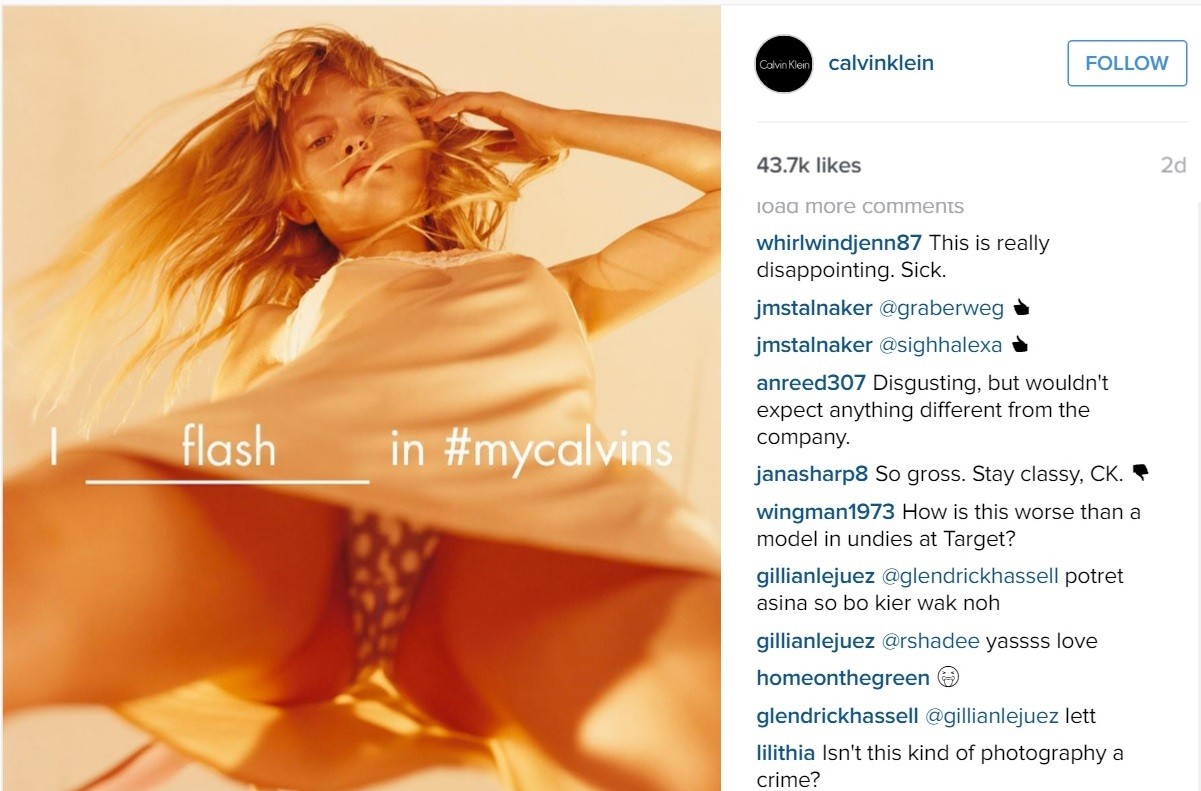
One thing has happened recently in the news. A picture posted by Calvin Klein. The ad campaign “I __ in my Calvins” revealed a new photograph showing an upskirt of a woman with the caption, “I flash in my Calvins”. Many of the previous versions saw stars such as Justin Beiber or Fetty Wap with the captions “I glow in my Calvins” and “I make money in my Calvins”. However with the new set of pictures saw the release of “I flash in my Calvins.” Many people in the comments called it misogynistic or disgusting. While I understand the outrage, I also believe that this picture shows women taking back their body. One Youtuber, who I highly recommend and often agree with, named Philip Defranco said, “women have lived through times where they were valued only for their looks. Many places boiling them down to objects that have only one thing to offer that is their looks. But what I personally see with this ad campaign is generations of women taking back their sexuality.” I wholeheartedly agree with this. As Philip goes on further to say, “It says ‘I blank‘ not ‘she blank’, ‘he blank’ but ‘I blank'”. Women have the power to do what they wish with their body and do not need to listen to others.

Moving to a slightly different discussion about body image. I am a 5’8 and 115 pounds male. For the entirety of my life (a very long 20 years!) I have been called skinny. I was once comfortable with my body and was totally alright with my body image since the reactions were only from my family. I believed the reactions were only joking comments, comments with some truth but nothing hurtful to make me change significantly. However I have understood that they were doing it for my health. That being so skinny could be dangerous health wise going further. But I have not even changed one bit. I have just taken it into account and have not acted towards it. That is probably my fault, probably because I am lazy. But what if I was a woman. Would I be treated the same? No way. Not a single person would be alright with the way I looked. Because I am skinny I will be shamed for it. Because I am a woman I will be shamed. Body Image is only a problem seen with women. Men never seem to have a problem with it. I personally am not shamed for my body but a woman in my position would certainly be.

Women have the right to their own body just like men do. If a woman wishes, under no pressure, to show an up-skirt picture of herself, she has every right to do it. Let’s grab the definition of feminism. It is “the advocacy of women’s rights on the grounds of political, social, and economic equality to men.” Equality to Men, that is what feminism is.

Week 1: Multiracial Feminism. India’s Daughter

What is Multiracial Feminism?

The phase “multiracial feminism” is defined as feminism based on the examination of dominance through understanding social constructs of race, ethnicity, tradition, and culture. An example is that a African-American women would face different challenges to that of an Asian-American women.

As an Indo-American, I have seen at first hand the different challenges that women face in both American societies and Indian societies. In particular I have seen Indian women as second class citizens for a long period of time. Women were not allowed to work and forced to take care of the children and home. Their husbands would be the breadwinners of the household and respected by society. Women rights were also for a long time rarely talked about in the media.

However in 2012, an incident happened that shook India to its core. The 2012 Delhi gang rape case caused India’s government to finally take a look at the way women were treated. I won’t go into the horrific details of the case but what I will give a small description of what happened. A woman initially known to the public only as  “Nirbhaya” (The fearless one) was travelling with a male friend late at night on a local bus where she was brutally raped, attacked and left to die for several hours before receiving medical attention. She was transferred to a specialized hospital in Singapore where she eventually died due to the injuries. For many days men and women stood protesting in front of the parliament building in Delhi demanding justice for the victim. A government known for its corruption and incompetence was unable to respond with an effective answer which lead to riots an several cities across India.

The Nirbhaya case allowed women across India to speak out about their rights and also caused media outlets to report on any rape cases and women’s rights actions. However, on March 8th 2015, on Women’s day, BBC released a documentary named “India’s daughter” portraying the incident in a different light. The documentary allowed one of the accused rapists to speak his thoughts on the crime before his trial. This caused the Indian government to ban the documentary within the country and went further to ask Google and the BBC to remove the documentary from their websites and searches.

Why did they go so far in removing the documentary? Simply because the documentary went against the Indian penal code. Section 228A states that the disclosure of a rape victim’s identity is punishable by law which the documentary did within the first 10 minutes. The documentary also portrayed India in a negative light. A view that India was a country full of rapists and governed an inept group of individuals. Though the Indian media was allowed to talk about the rape case, an outside perspective, one that was not controlled, was being shunned by the government. Even with the ban, millions of people were able to watch the documentary.

Alright so how does this tie in with multiracial feminism? Like the Black-Feminist movement, this is seen as one of the Indian-feminist movements. An incident that would pave the way for Indian women to be seen by the media and the way they are treated.


Design a site like this with WordPress.com
Get started